

MOMA: Model of Mosquito Aedes aegypti
- 1 oct. 2014
- 2 min de lecture
MOMA is a spatially explicit ecological agent-based model of Aedes aegypti female mosquito, vector of dengue. This model produces statistical data on mosquito behaviours and on population dynamic which are difficult to obtain on field surveys, such as population densities according to local spatial and climatic conditions. These data produced within our virtual laboratory will be used to calibrate another model of dengue at city scale, where mosquitoes are modelled at sub-population level. This virtual laboratory can also be used to explore effects on population dynamics of source reduction and vector control strategies.
In MOMA, agent mosquitoes can bite, rest or lay eggs and interact with an artificial environment which provides resources for their biological development. Environmental conditions such as land-use and climate can vary in order to explore the context dependence of dengue mosquitoes.
MOMA user interface allows you to define different simulation parameters as well as different outputs (graphics, maps). Most of the algorithms are described so that you can navigate in the source code to check mosquito behaviors. Feel free to modify or try alternate behaviors.

You can record activities of one mosquito during a simulation to check how realistic are its behaviours.

You can simulate activities of thousands mosquitoes and map their dispersal range: where are the mosquitoes?

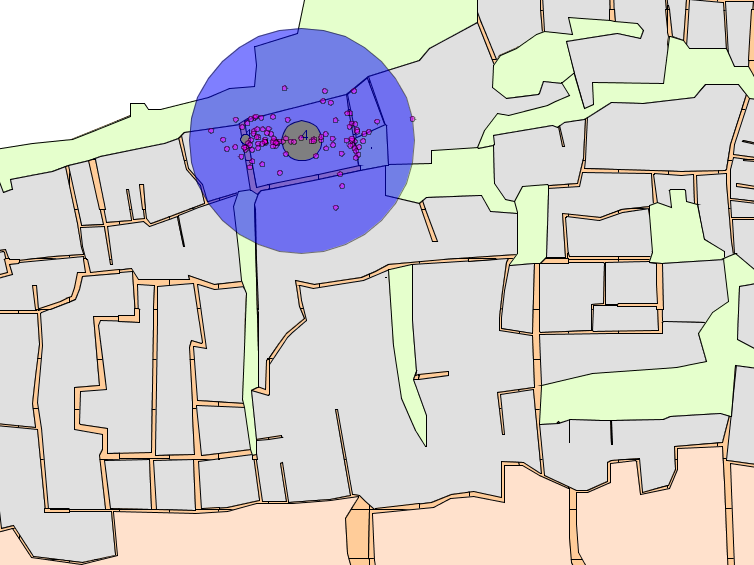
MOMA is developped using GAMA plateform. It uses geographical information data from a Geographical Information System (GIS). You can dowload MOMA and the data to try by yourself all the potentialities of this mosquito-based model.
You must have Gama on your computer: https://gama-platform.org/
Download MOMA model, Version 1.0:
If you use MOMA in your publication, please quote:
Maneerat S., Daudé E., 2015, MOMA: a spatially explicit agent-based model of Aedes aegypti mosquito, CNRS, UMR IDEES-UMIFRE CSH,
Commentaires